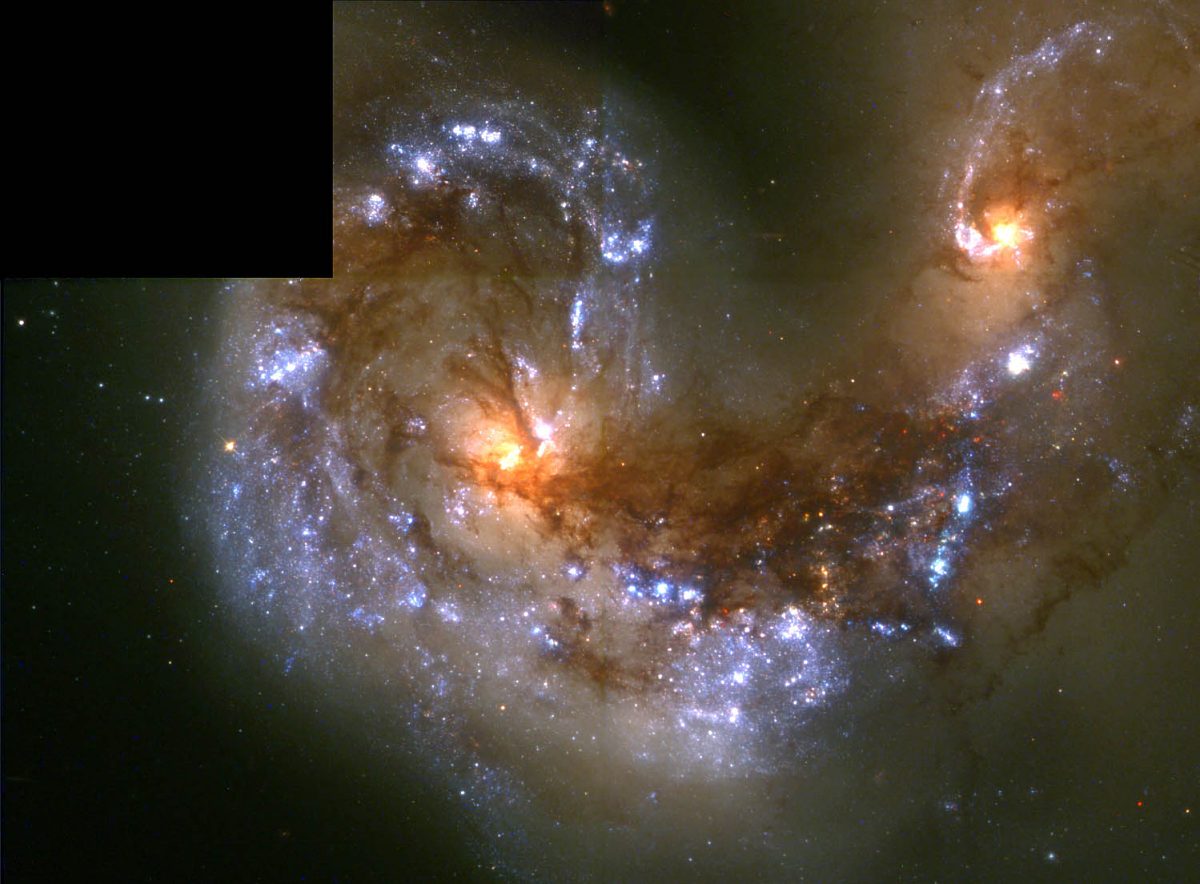
STELLAR FIREWORKS ACCOMPANYING GALAXY COLLISION
This Hubble Space Telescope image provides a detailed look at a brilliant "fireworks show" at the center of a collision between two galaxies. Hubble has uncovered over 1,000 bright, young star clusters bursting to life as a result of the head-on wreck. The Antennae galaxies (known formally as NGC 4038/4039) are so named because a pair of long tails of luminous matter, formed by the gravitational tidal forces of their encounter, resembles an insect's antennae (see wider view below). The galaxies are located 63 million light-years away in the southern constellation Corvus.
The respective cores of the twin galaxies are the orange blobs, left and right of image center, crisscrossed by filaments of dark dust. A wide band of chaotic dust, called the overlap region, stretches between the cores of the two galaxies. The sweeping spiral-like patterns, traced by bright blue star clusters, shows the result of a firestorm of star birth activity which was triggered by the collision.
This natural-color image is a composite of four separately filtered images taken with the Wide Field Planetary Camera 2(WFPC2), on January 20, 1996. Resolution is 15 light-years per pixel.
Image Source (above) Image Source (below)
